
Ashtavakra Samhita (Q&A)
Peace Ch 18 vv 28 – 34
In this discussion on Chapter 18 of the Ashtavakra Gita, Baba explains that a Self-Realized Yogi permanently abides naturally in the Self without effort, beyond the mind and the ego-sense of “I”. A Yogi functions in the world without mental involvement, acting spontaneously while remaining a silent witness. He emphasizes that Self-Realization is not becoming an enlightened person, but the merging of all personal identity into Pure Consciousness. Baba describes Pure Consciousness as existing in itself, like space, independent of all appearances, and he shares how this understanding was realized through deep meditation and tapas. Liberation is achieved not by acquiring knowledge, but by silencing the mind one regains awareness of their original nature as Pure Consciousness. Baba teaches that every thought is imagination, and suffering begins when the mind mistakes its own imaginations for reality. The Self is eternal, all-pervading, and exists in itself, independent of the changing world. Throughout the questions and answers, Baba repeatedly encourages seekers to quiet the mind through meditation and abide in the Self, where Supreme Peace is ever present. A Self-Realized Yogi performs actions without the sense of being the doer. He remains untouched by pleasure and pain, neither clinging to the past nor worrying about the future. True knowing is becoming one with Truth itself, where imaginations cease, the ego disappears, and Supreme Peace is realized as one’s own eternal nature.
Q&As – Ashtavakra Samhita Commentary with Shri Babaji
Register your free place for the live online meditation and Q&A with Babaji: Register
Ashtavakra Ch 18 vv. 28-34 “Peace” 2026-06-07
Agastya
Thank you, Babaji. Thank you for joining us. Thank you, everyone else, for joining us too. We’ll continue going through the Ashtavakra Gita—Baba’s commentary on that text. It’s an Advaitist text. Advaita means it’s not two. It deals with the one eternal existence, how to realize that and obtain Supreme Peace. We’ll be again with chapter 18 verse 28. I’ll read the text, and then the comments from Baba that are in the text, then Baba, if you would like to elaborate on anything or add anything, please just speak.
Baba
Yeah,
Agastya
Verse 28. “That one, having no distractions, has no need for meditation, neither aspiring for liberation nor being in bondage. Existing as that Ultimate Truth, even though seeing the universe, that one knows it to be only illusory imagination.”
Baba
Here, exactly what Ashtavakra says is, a Yogi doesn’t need to sit down and meditate anymore, he has no distractions at all, he just settled in the Self, into that oneness. But those who have still hundreds of thoughts and visions, their mind will get distracted easily into different thoughts and be preoccupied with judgments and analyzations. They would need meditation to stop this process. That’s what precisely he means.
Agastya
Baba, what does it mean no distractions?
Baba
No distraction means your attention is not anywhere else except on the Self, your awareness. If anything else appears, that can happen only through an imagination, so when your attention goes to your own imagination, you get distracted from your real Self. That is the distraction he is talking about.
Agastya
Do Yogis not have imaginations?
Baba
They don’t have, but if necessary, they can bring it in for a while. It will be for a very short while. If they are going to teach or give a teaching, they may use the nearest imagination, but that will not distract the consciousness of the mind. It will remain in itself—it realizes and is very well aware that the thought is not a reality. Then they don’t get involved much in imaginations at all and they don’t have any imagination in their consciousness. It is the ever silent one.
Agastya
What is an imagination?
Baba
When the mind imagines either a thought or a vision appears within the mind. That appearance has happened due to imagination or creativity in a little higher pitch. Both are the same, actually. Technology is the imagination technology. Consciousness is capable of imagining. When it imagines, immediately, instantly, a thought or a vision appears within the mind. The problem is, if the mind forgets that the thought or vision is there because of my imagination, and gets involved with the thought, considering such a thought or vision to be a fundamental reality—that is when the problem arises. Otherwise, the thought disappears. It is not there at all. Nothing gets registered.
Agastya
So, are all thoughts imaginations?
Baba
Totally. Anything that comes into the mind is an imagination.
Agastya
So it’s just the nature of consciousness, the creative nature of consciousness that gives rise to mind, which gives rise to thoughts, which gives rise to creation.
Baba
Yeah, probably because of the presence of energy in the consciousness, so this is what happens—imagination occurs. But if you don’t get involved, you are back into your Self, you are there, you don’t get distracted.
Agastya
How does a yogi function in the world without imagination or without thoughts?
Baba
Most of the time by others inducing him to do something if he is requested, “You have to come, you have to do this,” otherwise it may not occur at all what to do. This automatically keeps happening, so based on that the yogi does it mechanically without getting mentally involved.
Agastya
So if nature or creation needs to be dealt with, then it’ll arise. Otherwise, it just stays silent?
Baba
Like if you draw a beautiful portrait, and then forget about it. That means you don’t have anything in your consciousness, that you did it, or it is there, or what it is, nothing, no such imaginations occur further. That’s how the Brahma concept I have explained. Brahma creates an illusion, but never gets involved into illusion, because he is not interested. First thing is, this is important, if you are interested, you become inquisitive. Then you end up imagining. The mind can never give the truth, because it can give only what it imagines.
Agastya
So, Baba, here, I think you are referring to Truth as that which never changes, and which has always existed, because the mind can only give momentary existence.
Baba
The existence of anything will have only appearance value, but not actually existence value. For the sake of understanding, I use these terminologies. Existence means it should not disappear, it should be there. If it disappears, it means it had only appearance value. Like a cinema on the screen has only appearance value. It doesn’t have any existence value.
Agastya
Baba, if a yogi is in Supreme Peace all the time and free of desires, what motivates him or her to move or to act?
Baba
Nothing much of a motivation, perhaps a couple of things, maybe you can call them a sattvic ego, such as an attachment to the guru, and wanting to spread his message. And once you have Self-Realized, you would like to share it with others, so that others can also achieve and enjoy this Supreme Peace and Self-Awareness. That is all the motivation, nothing else is there.
Agastya
So, for a Yogi, the only motivation would be to help other people become yogis?
Baba
That is all. So, they also achieve peace—they need not suffer mentally.
Agastya
Thank you, Baba.
Agastya
I’ll read verse 29
Agastya
“One who still has the ego-sense of ‘I’ acts even when not performing actions. The one who has no sense of ‘I’ does not act even when performing actions.”
Baba
See the beauty. A person is sitting quietly, but he is active mentally. That is called the devil’s workshop. He (One with no sense of ‘I’) might appear to be eating and moving, but he is actually not active mentally. He is quiet.
Agastya
So the One who has no sense of ‘I” doesn’t act, even though he performs actions—this would be the yogi spontaneously carrying out activity, as a witness, witnessing the whole thing.
Baba
Yes, because the earlier idea of the ‘I’, which never existed, is all dropped, disappeared. So, when there is no ‘I’—the idea of ‘I’ doing something or not doing anything, doesn’t occur at all. It has no meaning.
Agastya
Yeah, there’s an interesting thing, I’d like you to clarify. Generally, people imagine themselves as a person becoming enlightened, an enlightened person, or a Self-Realized person. Whereas I believe the truth is that they realize they are Pure Consciousness, or Eternal Existence. They no longer identify with being the person. A person will never become eternal. It’s not possible.
Baba
Not possible. It is destructible. It will disappear. It has only appearance value, that is all. It will disappear. The body will decay, and it will go.
Agastya
I’ll read your comments from verse 29.
Agastya
As long as Self-Realization has not come, and there’s ego of imaginations in the mind, even if a person appears to be quietly sitting, they are fully active in the mind. A yogi has no ego or any imaginations in the mind, which is now pure consciousness. Even though they appear to be active, they are ever the silent one.
Agastya
Verse 30.
Agastya
“The consciousness of the liberated One is neither troubled nor pleased—actionless, motionless, desireless, free of all doubt.”
Agastya
I’ll read your comments Baba. “How a Yogi’s mind is liberated is because there are no imaginations, hence no desires, no need of anything, even for its existence. This pure consciousness exists in Itself. Thus, yogi’s consciousness is never troubled or pleased. It is total stillness and without any confusion.”
Baba
There is no more craving. Any craving is not there anymore. “I needed this; It should have been like this; It couldn’t go ahead like that”—such craving doesn’t occur at all. The Yogi is just quiet. In that silence, He is totally contented. When we look into divinity, when we realize, “My God, how to please this divine, It doesn’t need anything at all”. We offer and offer and offer, just for small work to be done in this world, and we think we will please the divine God. It means we start imagining when the body eats. Technically, if we look into the mind itself, then we will understand the mind, which has given the imagination of the ‘I’, actually cannot touch anything of this world: It cannot eat, it cannot give, and cannot take. Simply in imagination it enjoys—as if it is giving, as if it is taking. And it also gets troubled in imagination, as if it was troubled by somebody. It has nothing. Only the body eats the food. Aham bodhyam na bhakta—”I am neither the thing that was eaten nor the one who eats”.
Agastya
Baba, in this chapter you mentioned ignorance several times. Is ignorance just the belief that consciousness is a body—that our existence is a body?
Baba
Yeah,
Agastya
And mind.
Baba
Mind, also. Only when we go to that Consciousness of Existence which is simply infinite—you cannot catch it. It appears to be at one place, but you go on trying to catch hold of that through the mind or anything and you are unable to catch anything. You can get confused, whether it is there or not, but it is there. It doesn’t disappear. It is there, but you cannot catch hold of it. Such is the fun.
Agastya
Yeah. Baba, you have the saying, “You can’t make yourself disappear.” We are aware that we exist all the time. Nobody would say they don’t exist while they’re awake, yet we can’t say exactly what we are. We have thoughts and your activity of the day, those are changing constantly, but there is a constant, and that’s our Consciousness of Existence. We are aware we exist even without thinking.
Baba
Yeah, a person tells, “I was sleeping”. The “I” was there, but who was sleeping? The body was sleeping. So we identify “I” as the body, and the body that was sleeping as the “I” sleeping— whereas that was not the truth at all. It was the body which was sleeping. The body woke up, and the moment the body woke up the brain became active, giving you consciousness of the surroundings and the world. But if there is no imagination, you remain as a witness. You are seeing, but not getting involved. You are not defining anything. You are not making any judgments. A Yogi never judges anybody, anything, whether this is good or bad, needed or not needed, or anything. Whether he is in the midst of hundreds of people or he is just alone bodily, it is all the same. He is unaffected—at peace.
Agastya
Baba, it says, “Pure Consciousness exists in itself. Would you explain that?
Baba
Yeah, this language is used in Yoga Vasistha Ramayana by Sage Vasistha, while teaching Shri Rama about the yoga of union with the divinity—that Truth exists in itself. The things that are in front of you, all the matter that is there: your bed, a painting, a photo, a table, a body, and a computer, a door, walls, everything is there, they all exist in the space. Without space, they could not have existed at all. Space doesn’t exist in any matter. It appears to be, but even without matter it can exist. That is how it exists in itself. Though it appears to be existing inside the room, inside the bed, or inside the earthen pot, it is really independent. It is not binding itself in anything. It is an illusion that is created, but it is totally independent, and exists in itself. You remove the whole earth, throw it away, if you can. Suppose you get an energy and powers, and you throw the earth a long distance, you will see the space is there where the earth had existed. But if you try to catch the space and try to throw it through any means, with your hands or through any other means, you can’t. You take a bag and think, “I am going to fill this bag with space and throw it.” You can only throw the bag, the space remains there, that is the meaning of it ‘exists in itself’. In another session, I was telling in 1977 I was reading the Yoga Vasistha, as my guru had recommended, telling me that it consists of his philosophy. Suddenly this line came, “Hey, Ram, that Truth is all pervaded. I see that all the time”. This all pervaded, we have seen in other scriptures also, but suddenly he tells,”It exists in itself.” I repeatedly read this sentence several times, probably 8 to 10 times—”It exists in itself—It exists in itself”, as it is—”It exists in itself”. Then it occurred, “Oh my God, God is everywhere, how can he escape? I am seeing God. This space is God, nothing but God. This space is the divine.” This space is not simply an ordinary void place, it is supremely conscious of its own existence. It is Supreme Consciousness, and not simply an inert void place that people say is nothing. While trying to go into logic, you tell it is nothing, and it appears to be nothing, but you tell it is something, and it appears to be something. The room is filled with space. The room is void of space. Like that, I thought, and I was thrilled and bewildered, thrilled and thrilled, like that—”Oh God, I got it!” I said to myself. I was sitting under the mango tree behind the Dehradun ashram when I read this. Then I went to meditation, and simply it was peace, supremely peaceful, like that. Practice became more smooth and more easy. I just needed to remain like that, and the time used to pass by like anything. Six to seven hours used to go by like two minutes, and finally the five years of tapas simply went by like minutes.
Agastya
Baba, are there any thoughts that can give liberation? For example, you had an insight, an inspiration, a realization. Was that on the level of a thought, or was that in consciousness? Did your consciousness momentarily expand?
Baba
For me, there was no such idea or imagination that I had become realized, simply that time of five years was over and this body will come out, the tapas will be over. Then everybody called, “Oh, Baba is realized now, he has completed his tapas”. The story was also written, and when they asked, are you realized, I said, “Yeah, I’m in myself. I am just quiet, that is all.” Otherwise, there was no such thrill that “Oh, I have become realized”. I did not declare any such thing at all. Some gurus have tried to declare, they were sitting on a boulder for three days, and became enlightened. Such a thing never happens at all. The mind, when it becomes totally quiet, where is this imagination that “I have become enlightened”. This imagination will never occur. Until this day, I have never imagined that I am realized at all. Simply, I am going in this world with this body and trying to teach. If a question is asked, to answer that, I might have (a thought arise). As far as I remember, nobody has even asked me, “Are you realized.” That type of question has never come. Luckily, I was not asked, I would be bewildered; I don’t know what to answer if anybody asks.
Agastya
The person doesn’t become realized.
Baba
Yeah,
Agastya
Okay, Baba, thank you.
Agastya
Verse 31. “The consciousness of the Liberated One has no aim to be meditative or to be active; it simply becomes meditative or active spontaneously.”
Agastya
Your comments. “After Self-Realization there’s no need for any effort to meditate as the mind is now a pure consciousness without any imaginations, and it is always in attention to the Self. Just like being there. A yogi’s mind can become active without any desire or motivation; then it does not absorb any imprints. When it becomes quiet, it is pure consciousness. No habits are acquired by the consciousness of a Yogi. After Self-Realization a Yogi’s mind is liberated to regain its pure form of consciousness.
Baba
Means a yogi doesn’t entertain any type of attitude towards this world or towards anybody, neither positive nor negative, no comments and no judgments, because it’s the Self. Simply the Self, that is how it is just a witness and quiet.
Agastya
Baba, if you had to give an identity of yourself, just for the sake of words and understanding, what would you say? How would you identify yourself?
Baba
I’m the silent One. I exist in the Self. I simply exist; I don’t do anything else.
Agastya
Would you say, you are the existence which is silently witnessing everything that is occurring or not occurring within you?
Baba
Yeah, because nothing registers in me, actually nothing exists. Though, for the sake of saying, I might say, I am the witness to what is happening, like a universe is there, a world is there, so that you all will recognize. If I tell, I just see something and I don’t know what it is, you will be bewildered. “How can Baba tell that. This is the world; he knows it very well”. That is how sages like Ramana Maharishi have always addressed the body as “This is.” ”This is going in search of its Father”, like that he left a note on a piece of paper, and then left home. This, this, this, only he used to address. After he realized, he became just quiet and did not address anything, anybody in any way, that is all.
Agastya
You say, “The yogi remains quiet and does not experience any destiny mentally and watches as a witness. When eventually the physical body is dropped, the Yogi remains established in the Ultimate Truth, without any rebirth or any more illusions.”
Baba
Yeah, people discuss so much about karma, karmic theory, destiny, this happening, how to stop, how to do. Because nothing occurs in my mind, just for the sake of teaching, I tell them everybody undergoes the prarabdha (karma) in the body. And that body while undergoing, if an imagination registers in the mind, one suffers; otherwise, there is no suffering. I cannot keep anything for a long time in the mind, within moments that gets erased. Somebody would have criticized, abused, and I cannot go keep it for a long time. It simply disappears. Like writing on a white paper, whatever is written instantly disappears, so it doesn’t register.
Agastya
Baba, I think most people’s mind have something going on all the time, like imagining and remembering.
Baba
Yeah, almost all people, I would say. All the time something is going on, it’s a chatterbox, it keeps imagining. It happens through brooding about the past, or anxiousness about the future. An unknown fear arises: “What will happen tomorrow? When death happens, what will happen to me? I don’t want to die”. This type of thing can cling on in the mind; it broods about the past: “Oh, our parents were there, our siblings were there, I was very young, I was a child”. That childhood thing keeps coming to the mind, and the mind broods, but such a thing has disappeared for a Yogi—No past and no future.
Agastya
So, being involved in your thoughts constantly you’re unable to see your Self.
Baba
Yeah, nothing actually happened to me, and nothing is going to happen to me. This body may experience something, but the mind will not suffer. Pain can be there in the body, but still the mind will not suffer. The mind experiencing pain in the body, and due to that pain the mind suffering, are two totally different things. If the mind considers that as a true entity, then it suffers, then it registers, then thoughts are generated, hundreds and hundreds of thoughts are generated. “My God this pain is there. This body is undergoing pain, such a thing should not happen in my life. Whatever I wish, should come.” Such a thing, not necessarily—sometimes it happens, sometimes it doesn’t happen. A disciple comes, and then a disciple goes away, abusing the guru. These things keep happening, so it doesn’t get registered in the mind, and the mind doesn’t suffer.
Agastya
Baba, can a yogi have a desire? Could he wish something for the world?
Baba
No actually, a Yogi doesn’t even feel sorry, because nothing exists. Everything is only an appearance. You are the director of the movie, and you know very well when the shooting of the movie happened. Now you are watching the movie, you don’t see it as a realistic existence at all, because you are well aware of what was happening behind the scenes when shooting the movie. “Oh, this actor was doing this, this is like this”, such thoughts might come here, that doesn’t come, because it never got created. It was never shot. This movie was just an imagination, and it appeared. Nobody acted to produce the world.
Agastya
The world is not because of our own desire or making? What produces it?
Baba
Your previous life’s resolutions could be. But still this body is alive, and as long as this body is alive, you get to see the world as a witness. This appears, but no judgment of what it is.
Agastya
Verse 32. ” On hearing the real truth spoken, an unreceptive, dull student might become bewildered. A more qualified student might withdraw his mind’s activity as instructed, and might thus appear like a dull fool.”
Agastya
In your comments, you say, “An ordinary person, though he acts like a spiritual seeker, may be totally confused on hearing about the ultimate truth. That means one is not yet ready to grasp the meaning. Knowledge of the ultimate truth is very rare. If he needs to be active in doing some service to the Master, quietly without any resistance, withdrawn in the mind, a devotee would continue serving. Whatever he is doing, such a seeker would take care that the mind does not arise with the ego of imaginations. His sadhana continues unknown to the world.”
Baba
You learn how to bake the bread and then you go on baking. Every day, you won’t claim, I have learned how to bake the bread. I have learned how to bake the bread. It becomes so common for you, that you simply go on baking. You don’t need any recognition, or any certification. You don’t want to declare to anyone—you simply bake it.
Agastya
I think that’s true. When we’re learning, we go through the whole process, or if you’re trying to show someone.
Baba
In the beginning there could be excitement, “Oh, I’m learning how to bake the bread. Oh, I’m learning about the ultimate Truth. My guru is teaching me.” But once you settle in the Self, it all disappears.
Agastya
Verse 33. “Those who are perplexed constantly practice concentration and control of the mind; but the Wise—abiding in the True Self, like someone deep asleep—do not find any actions needing to be performed.”
Agastya
Baba’s comments. “The ignorant are unable to remain quiet in the mind. They always keep troubling to control thoughts, but continue to analyze and make judgments. Thus, Self-Realization becomes a long, long journey, awful, often giving confusion to whether it is possible or not. The wise grasp the actual meaning of the Master’s teaching and learn to keep quiet mentally, so abiding in the Real Self becomes natural for them. In fact, ‘do sadhana and meditate’ means learn to keep quiet mentally. When the mind becomes quiet once and for all, automatically going introverted, its attention peacefully turns to the Real Self, and eventually merges in the Self.
Baba
You see, for common people, whatever is happening in their mind is what they consider the actual truth. They don’t know what the outside world is. Nobody knows, they try to define it based on their own imaginations, acquired either by the recommendation of another person, or by their own determination they define a certain thing. This is how it happens. So often people are prejudicial, means they have preconceived a meaning.
Agastya
Baba, you’ve frozen. We’ll wait for Baba to come back. You’re back.
Baba
Internet connection is unstable, it says. But my mind is stable. You are frozen now. If you are still
Agastya
Okay I’m back. My mind is not stable, Baba.
Baba
So things appear to every person based on whatever they have in their mind. Based on that, they talk, they act upon everything. One person abuses you, another person loves you, another person cares for you—that’s happening in their mind. That’s what’s happening. Even a Yogi gets to see this.
Agastya
Baba, I think we all get to see that today. A good example is the internet, with it, everybody can voice their opinion, and you get to see the reality that’s going on in each individual’s mind. Everybody has a means to post or tell the world about their mind, and it can get pretty bizarre.
Baba
Yeah, when they ask questions you get to see: what is happening in their mind; where they are; what they are thinking; what are they doubting; what are they suggesting; what are they believing. So many things you understand. Then you try to tell the Truth, just become quiet. As Ashtavakra told Janaka—quiet!
Agastya
Yes Baba, that is the way out of the confusion. Today it can be overwhelming, with so many mixed messages and your mind is trying to make sense out of them. Having the ability to withdraw from that, and silence your mind is really grace.
Baba
You see in today’s world so many gurus are cropping up, and though they have not experienced it, they try to talk about the Ultimate Truth in their own way. They end up speaking all imaginary things, what they have imagined, or would have read or heard from a book. Some imagination that comes, “This is what it is, this is what it is.” And generally, how they get caught, they identify their experience of the Ultimate Truth in such a way which is everything except the Ultimate Truth itself. They define the Truth as a color or a pearl or some light. Like this they will try to explain, and you understand they are not yet enlightened.
Agastya
Yeah, there are not many people that teach about the Self. There are other gurus that talk about the Self pretty exclusively, however, that doesn’t mean they are enlightened.
Baba
Yeah, they would have read in books. They could be scholars, but scholars also will be talking based on the imagination of what they would have read in the books.
Agastya
Verse 34. “Ignorant people do not attain peaceful happiness by either action or inaction; but for the Wise One simply knowing the Truth gives peaceful happiness.”
Agastya
Baba, here, what constitutes knowing? And can thoughts liberate a person?
Baba
Many times people think when they read a book, that knowing, like this, is the truth, but that is not the Truth. They have just come to know of somebody else’s imagination about that Truth; they have read it. Only when they experience it, when they become one with it, when they become quiet, will they then get realized. Self-Realization is like that, you get realized, but you cannot make others realize what you have realized.
Agastya
Right, because the only way to know that Truth is to become Truth. You are that Truth. You can’t know it, because that would take you immediately out of the Truth.
Baba
Any such knowing happens only in a relative existence. As long as you have the imagination of yourself as an “I” existing or an “I” needing to know something”—then these things happen. Otherwise, when the “I” is dropped, there’s actually nothing to know. Just be there, abiding in the Self.
Agastya
Baba, in higher states of consciousness, I believe you said there’s kind of a gap between the relative and the absolute, and in that gap, knowingness of the Self can happen—as long as you have a body or a nervous system.
Baba
Yeah, that existence is an eternal existence. Otherwise, once you merge, there is nothing that you know or anything to know. Whether you exist or don’t exist, nothing comes, because no imagination at all comes to the consciousness. It is still, in Samadhi, that is what is Maha Samadhi. So no imagination comes. As long as there is a relative existence, the relative small droplet tries to know: “Oh, that is the ocean, that is my ultimate Truth.” “Oh, that is eternal existence, I could not make that disappear.” “Oh, that is me, actually.” Like that, a thought can appear just before the merger, but once you merge, it’s all over. All ideas are dropped. The “I” is finished. Once the “I” is finished, whatever I had known, whatever I think I know, whatever I could know, all ends.
Agastya
The ignorant or unrealized person might hear that and think that is a state of zero, but in fact it’s a state of infinity, I suppose.
Baba
Yeah, it’s not zero, also. It’s beyond, because zero gives a certain imagination of nothingness. Zero and absolute are two different relative existences. As long as these two are there, it is not the Truth. It is neither absolute nor zero.
Agastya
Thank you. It is about 10 after, would you like to take a few questions?
Baba
Yeah, a few questions we can take. For another 20 minutes we will be available. So many have raised there, hand.
Speaker 1
Pranam Babaji. If you can explain once more, Satyam Shivam Sundaram. That day you did explain, but I really didn’t understand. I don’t know, it is just too high for me.
Baba
That is the Truth, that is infinite, and that is beautiful.
Speaker 1
Oh. Thank you, Baba.
Baba
Next, Rizwan, please come in.
Speaker 2
Yes. Hello, Babaji. Can you hear me?
Baba
Yes, I can.
Speaker 2
Babaji, maybe this is a very obvious question. Because the ultimate Truth is all pervading, and as you have said many times, it has unlimited potency, why are the thoughts in our very limited human mind capable of blocking out this Truth. Why doesn’t it completely pervade our mind in spite of our ignorance?
Baba
Because it has imagined an “I” which does not exist. That imagination of “I” has limited the thoughts themselves into a limitation. That “I” is a limited one, which we call mind, and thus the thoughts that are in the mind are also limited.
Speaker 2
But the power of the ultimate Truth, can it not just erase the “I”? What is it that keeps the “I” so strong that it can block this power?
Baba
It can erase, provided you get connected to that, but you are going away, away in your own imagination. You are totally preoccupied, involved with your own imagination, to such an extent that what you have imagined has blocked you from knowing your real Self. Your attention is all on the imaginations you are making, and that imagination flows continuously 24 hours. The moment you wake up, it’s a talking chatter box. Stories build up, build up, build up, and it imagines it may get some peace in that, but peace is elusive. Thus, it is blocking itself by paying attention to what it has imagined, rather than its reality.
Speaker 2
So is this blocking something we do voluntarily as humans?
Baba
By habit.
Speaker 2
By habit.
Baba
Habitual.
Speaker 3
Okay, Baba. Thank you.
Baba
In a way, the word voluntary is okay. Voluntarily, you start and get involved into the habit, I can say like that.
Speaker 3
Okay, okay. Thank you.
Baba
Brenda. Please come in.
Speaker 4
Thank you, Baba. I already know your answer, which is be quiet and watch. You’ve already given that to me. However, I am in the world, and I’ve seen it’s all lies. At this point everything is a lie, and as a being seeing it, it has built up to the point that I’m not in peace unless I close my eyes and meditate. But I can’t just meditate because we’re headed for an iceberg. Okay, so my imagination has gotten out of hand. My question to you is, How do I navigate knowing that it’s all a lie? Does that make sense? Be quiet and meditate, but I still have to operate in the world, and if something’s coming at us to harm us, How do we get out of the way?
Baba
At such a time, when the mind is so habitual to knowing it is a lie, but you are unable to get out—there is an antidote. Once you realize there is a time bomb under your chair, what will you do? You will go out of your way to save yourself first, that becomes the priority you will set. All the rest can happen afterwards. If there is food, it can wait. If someone is dear to you, they can wait. First, you need to save yourself, otherwise you will be gone. Here, in the chest, inside is a heart named Time Bomb. It is clicking every moment, it is pumping blood. At any time it’s clicking can stop, and the blood flow will stop, and that is done. Until then, there is an opportunity for you just to watch these lies and not get involved. Do not think of them as a lie, even if they are a lie. Don’t think of a lie as a lie in your mind, then when the mind becomes quiet, that lie also disappears. That is the only technique you need to understand. You just have to become quiet, and they will disappear. Bless you.
Baba
Okay, next come in. Nick.
Nick
Babaji, can you hear me?
Baba
Yes, yes.
Nick
Hello. You said a few minutes ago, it’s hard for a Yogi to feel even sorry or concerned with the hard things that are going on in life. But I also know that a Yogi is pure compassion, an embodiment of compassion. So, can you define compassion for me in the correct way?
Baba
Yes, definitely. You are right. When somebody prays, telling this is troubling me, this is making me suffer, this is making me unhappy, then compassion occurs. Unnecessarily, the soul, considering things of this world to be a reality, is suffering in imagination. First, let me help remove that imagination and that suffering. Then the teaching can be given for a person to remove the imagination. We will pray to divine, also. You have to help this person overcome this sadness. Then he can give some time to understanding that he needs to get rid of his own imaginations. But first some feeding of consolation. So that’s how we pray, we become compassionate, but that will not affect us.
Nick
Yes, so unconditional love,
Baba
Yeah, unconditional, like a doctor attending a patient. If a doctor becomes emotional, he will go mad, and he won’t be able to attend to the patient.
Speaker 5
Okay, I understand. Thank you, Baba.
Baba
Yeah. Next, Anusha
Speaker 6
Pranam, Babaji.
Baba
Yes.
Speaker 6
So Babaji, you were mentioning that when you were doing your tapas and you were putting in hours of meditation, time just flew by, and would never even realize how many hours you were putting in. So, then what is this time? I think, with many of us, like when we chant, or when we’re doing anything, time just flies by. Is time is also an imagination? Is it also an illusion of mind?
Baba
Yeah. When you notice the imagination grows, and then you feel bad about it. Like for example, you get a sound sleep in the night. The eight hours of sleep can pass by like two minutes, but if you don’t get to sleep every now and then you will be watching the clock—”Oh, still it is not moving”. It will appear that time is moving as ages. Based on your imagination only, things appear. Actually, there is no such thing. There is no movement at all. When the mind moves, when it wavers, then it creates these time and space imaginations.
Speaker 6
So that is why it is said, live in the present, because it’s only the present that is there. I mean, there is really no past, there is really no only future.
Baba
Only the present, actually, there is neither past nor future. Until it comes to the present, you don’t know the future. The past is over, it’s finished. It depends on the mind’s imagination. You see, for a coward it might be painful or fearful to go to the battlefield, but for a valiant soldier, it is just nothing. He knows either he will do or he will die. That time passes by, he doesn’t imagine anything, so there is no difficulty at all. He just fights, whether he wins or he dies. Like that, this world is a challenge, always. We just go ahead, keep going, keep going. I tell, don’t even stop and look back about progress, you are wasting your time. Just go on meditating every day, whether anything happens or not, some amount of cleansing definitely happens—peace will descend. After some time you will notice that there is peace, and you are not noticing time at all—days, months, and years will pass by like that.
Speaker 6
So for a Yogi, Babaji, there is really no space and time?
Speaker 4
Yes.
Baba
No imagination, nothing is there in the consciousness.
Speaker 7
Thank you.
Baba
Our blessings, Shalini, please come in.
Speaker 8
Namaskar, Babaji, thank you so much for your time helping us navigate through this world. Babaji, what is the purpose of God and this creation?
Baba
There are different schools. Actually it has happened only due to an imagination. Perhaps in duality only, you understand your existence as eternal, that is one thing in my opinion. Because when there is oneness, there is no understanding of eternity at all. No such imagination occurs. Only when there is relative existence, in that relative existence only, you realize that your real Self, your Ultimate Truth, is eternal. When you go on meditating, one day you might achieve silencing the mind, all thoughts and visions will disappear. You will see at that time the Consciousness of Existence will always be there, and you cannot make it disappear. You will realize that as yourself.
Speaker 8
So then Babaji, my second question is, Can Yogis time travel?
Baba
They don’t do that one. Anybody trying to do that is not a yogi. A Yogi is in the Self Existence, time is over. The time was an imagination only; there is no such thing called time. There is no past, no future; it is all over, it was only in imagination, so one must not try to go for time travel. That might appear exciting in this world, but actually no Truth is there. It will be simply mind-boggling and can drive you mad unnecessarily.
Speaker 9
Thank you. Thank you.
Baba
Blessings, our blessings. Ribhu, come in.
Speaker 10
Pranam, Babaji. Today I want to ask you, what does one hour of perfection in meditation look like? And can Baba please grace us with some details of that state—like what happens?
Baba
When you sit for one hour physically and close the eyes, that itself doesn’t mean you are able to meditate one hour. You might be able to sit for one hour with closed eyes, but inside the mind must stop. It should not be working. It should not be creating stories. Totally focused, not distracted, in the quietness for one hour, when you are able to keep your mind like that, that is the real meditation my guru used to tell. Until then, you are trying to meditate. If the mind is running like a monkey, you are trying to bring it back and make it quiet. It is running, and you are bringing it back, that is trying to meditate. Finally, when the mind settles down, then your attention is there. That means you are meditating.
Baba
Priya Naya, please come in.
Speaker 11
Thank you, Babaji, for your blessings. I understand that we have to meditate, but you know everything. I’m struggling a little with my circumstances. I pray for your blessings, for strength and wisdom, so that I don’t sway away from my goals in life. You know everything, I just seek your blessings for strength and wisdom, so that I don’t get lost.
Baba
Our best wishes and blessings are with you. Meditate every day, you will be blessed.
Daniel, please come in.
Speaker 4
I’m new here, but I’ve been meditating for many years, however, I just started doing your meditation. Because of a tight neck and shoulders I’ve had a habit during meditation of making adjustments, like doing movements, but I know that in this meditation one does not do that. So I have to sit, and when I feel myself being pulled inwards, I can feel things tightening up, even though I’m relaxed. So, I just have to bear it, but not think about it, right?
Baba
Yeah, you have to practice not to move the body. The body’s movement is one of the basic reasons which prevents the mind from becoming quiet. It gives a jerk to the mind, and starts it spinning more, that is why it is important that the body is stationary. You can sit in any comfortable posture, any way that is comfortable for you: onto the wall, or keeping a cushion, or pillow if necessary, any such thing, so you try to avoid moving. Slowly, if you practice, you will succeed, then the meditation will be smooth.
Speaker 4
Okay, and then if I start to lean, if my body starts to lean by itself, is it okay to bring it back to vertical?
Baba
Yeah, without thinking anything, just try to bring it back and keep it upright. It will be all right.
Speaker 4
The other question is, I used to do Transcendental Meditation with a mantra. With it, you would gently introduce a mantra, and kind of ride the mantra like a magic carpet, and the mantra automatically would refine. Then the instruction is that if one realizes one is off the mantra to gently bring it back, but I found that I was always micromanaging my meditation. Like, “Am I thinking the mantra, is it there, is it really the same as the original mantra, or is it just refined. I decided that it is so much trouble. The meditation that you teach, uses a fixed point, there’s no management necessary, it seems.
Baba
Yeah, I have always told it’s like getting recruited as an officer directly, you don’t have to become a clerk and then get promoted. When the mind gathers on its own without any external anchor, it goes introvert, it takes the awareness of the Self, it merges with the Self, it becomes easy. That’s how one can obtain Self-Realization. Otherwise, it can be stuck onto some mantra. Mantras, they are good, not bad at all. All such methods are preliminary exercises to practice single pointedness of the mind. Instead of having millions of thoughts, you try to have one thought, that of the mantra, so you focus on that. Finally, you need to abandon that mantra also, so that the mind can go introvert. A silent meditation is important. It is one of the highest methods practiced in ancient India. Then, afterwards, in medieval times, japa and other things have been given to make it a little easier for many people. So, if you go on doing for some time, eventually, if you can switch on to silent meditation, you try to do this silent meditation also. If it works for you, it is well and good. Thank you. Our best wishes, blessing,
Ryan. Come in.
Ryan
Pranam, Babaji. I made a mistake that was related to my future and an identity that meant a lot to me, and because there’s a daily reminder of what could have been, I’ve had a lot of trouble forgiving and forgetting the past. If it’s a very big event does it is just take time and meditation to heal and get over my agitation?
Baba
Yeah, you see, by being unable to forget about the past—whether you committed a mistake or not, is no problem, it is over. You are committing more mistakes by being unable to give it up and by being unable to accept what happened. This is much more of a mistake. The mistakes are being continued. You need to stop doing this. The past is over, whatever mistake you have committed don’t repeat it next time. An opportunity will come in life, always. Wherever you are now, remain satisfied, choose that. So, let it be, it will give you more peace. Your peace and focus are more important. Simply brooding about the past, that you committed a mistake, will not bring it back. It will not help in any way. This is necessary—if you love me, you will consider what I tell you, and do it. You will be all right. Our best wishes and blessings.
Speaker 2
This is just a continuation. I realized when you were speaking about time—the fact that there is no time. I realized that we have actually never been not realized. If there is no time, there can be no time, even for imaginations. So, in a very peculiar way, the imagination makes you believe that you are not realized, and this is what we have to go through and discover through meditation, right?
Baba
Exactly, you are right.
Speaker 12
Thank you, Baba. Thank you, thank you so much.
Baba
Let me go to the gallery to say bye-bye to you all. I’m a love and blessings, and it’s time to disappear.
Key Points: Ashtavakra Ch 18 vv. 28-34 “Peace” 2026-06-07
- A Self-Realized Yogi no longer needs to meditate because the mind has become permanently established in the Self.
- Distraction occurs whenever attention leaves the Self and becomes absorbed in imagination.
- All thoughts, visions, desires, and mental activity are imaginations arising within consciousness.
- Suffering begins when the mind mistakes its own imaginations for reality and becomes involved with them.
- A Yogi may use thoughts when necessary, but remains ever-aware that they are only momentary appearances in consciousness.
- The mind can never reveal the Ultimate Truth because it can only produce imaginations.
- The world has appearance value but not true existence, while the Self alone has eternal existence.
- After Self-Realization, the ego-sense of “I” disappears, and actions continue without any sense of personal doership.
- A Yogi remains mentally silent while actions occur naturally and spontaneously.
- Pure Consciousness exists in itself, independent of the universe, just as space remains unaffected by everything appearing within it.
- Realizing that “Truth exists in itself” independent of the world leads to effortless, profound peace.
- Self-Realization is not becoming an enlightened person but recognizing oneself as the eternal Consciousness beyond the body and mind.
- The liberated mind is free from craving, judgment, fear, doubt, and the need to possess or achieve anything.
- A Yogi remains a witness to all experiences, unaffected mentally by praise, criticism, pleasure, or pain.
- Ignorance is identifying oneself with the body, the mind, and the imagined sense of “I”.
- True spiritual knowledge comes only through direct experience; reading or intellectual understanding alone cannot bring Self-Realization.
- The purpose of meditation is to quiet the mind completely until it naturally merges into Pure Consciousness.
- Time, past, and future are creations of the imagining mind; peace is found only in awareness of the Self.
- The greatest obstacle to peace is habitual brooding over the past and anxiety about the future, both of which disappear as the mind becomes quiet.
- The direct path to Supreme Peace is to meditate daily, withdraw attention from the minds imaginations, and become established in Pure Consciousness.
0:29 What is pure intelligence?
2:05 It seems that the creation is orderly, is that organizing power of consciousness through intelligence?
3:57 Could we call that intelligence cosmic intelligence?
5:15 What is the relationship between intelligence and mind?
6:41 Is it discouraged to have many practices?
8:51 So faith is important, because with faith you get direction and dedication?
10:10 Verse 36
10:31 How do you directly realize the truth?
12:19 “Only the blessed ones, through understanding of the master’s teachings and adopting proper technique in sadhana, will easily achieve Self-Realization”.
13:19 Verse 37 – “The wise one simply realizes their own true nature is that Ultimate Truth, without ever desiring it.”
14:19 You have to stop thinking to know the Truth.
15:26 :For the wise one, all desires recede with humility and surrender to the Master and Self-Realization happens in a simple way.”
18:22 The idea of surrender is that you are surrendering to your Self, and that means you’re letting go of everything that the mind is presenting.
20:09 Verse 38 – The wise stop all analyzations and judgments, thus ending all imaginations of the mind, which are the root cause of all misery.
22:26 How can we develop an attitude of surrender towards the world of thoughts?
24:06 Does a Master have to be a physical person, or can the master be formless?
25:51 Verse 40 – “..The Wise do not target any object and simply become quiet and become aware of the eternal Self.”
27:44 The technique that you’re teaching us is completely without control. It’s just letting go?
30:50 Verse 42 – “Some think that existence is real, while others think that nothing really exists. Rare is the one who thinks neither, and thus settles, free of distraction.”
32:00 We have a limited ability to control what’s happening in the world, but we do have the ability to quiet our mind or try to quiet our mind?
32:54 The ego kind of keeps us engaged in the drama. Ashtavakra speaks a lot in this chapter about ego.
33:50 What is the ego?
35:33 What makes the ego form? You said it created for itself.
35:25 So the ego is just a misplaced identification?
37:40 Does creation happen without ego, just spontaneously or automatically?
38:15 Do other beings have egos, or is this just a human thing? What about animals and other beings.
39:24 How do we become egoistic?
39:40 If you could become non-egoistic by thinking you’re not egoistic, it would be pretty simple, but it doesn’t work that way.
40:13 Is willpower a function of ego?
41:00 Then it takes ego to obtain Self-Realization?
41:14 “For the ignorant one, who gives so much importance to power and status, the mind never comes under control…”
42:30 Verse 42
43:17 Verse 43
43:39 We’ve seen people saying, “We’re all one”. Mentally, they are telling themselves that, but they haven’t really realized the Truth?
44:47 If I’m able to steady my eyes and use control to steady my eyes, then the surrender can be there or is available?
47:33 How what Jesus has said, “Forgive them, for they know not what they do”, applies to us now.
48:55 Symbolism of Shiva and Shakti appearing to Swamiji.
50:55 I have doubt regarding meditation technique. I could not find the certain point between eyebrows to fix my sight on.
54:04 Is thinking habitual and is sadhana really creating the habit to remain in the Self?
54:41 Along with meditation, is it also important to include prayer as a daily routine?
55:41 If there is no “I”, who is realizing the Self?
More About The Self
Tapas goes beyond meditation, involving mastering the mind amidst life's challenges, cultivating patience and self-control in all situations.
The mind is not thoughts or imagination but consciousness itself, which reveals itself as the Consciousness of Existence — the true Self through meditation and awareness.
Babaji describes the Self as the eternal, unchanging consciousness, distinct from the impermanent body and mind.
Spiritual practice is to bring the attention from thoughts to your real Self.
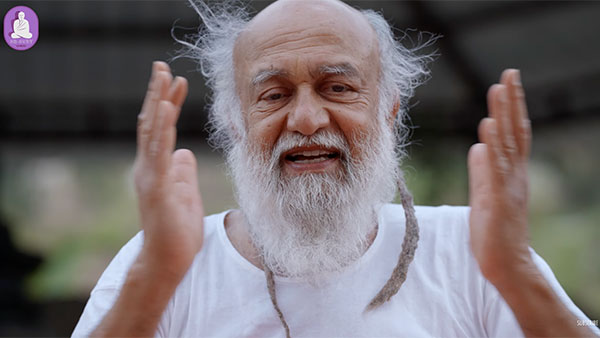
Baba shares how the aim and purpose of spirituality is to know yourself as the Consciousness of Existence.