
Ashtavakra Samhita (Q&A)
Peace Ch 18 vv 18-27
This question-and-answer period centers on the nature of Self-Realization, liberation, and the life of a Self-Realized yogi. The discussion explores how true Peace is neither a condition of the mind nor dependent upon the world, but the natural state of the Self when the mind becomes silent and all imaginations, desires, and individuality dissolve.
Baba explains that a yogi lives in Supreme Peace because the mind, having discovered the Self as Pure Consciousness, no longer identifies with the body, mind, or actions. Peace is described as beyond joy and sorrow, beyond existence and non-existence, and beyond all concepts. A liberated yogi acts in the world without a sense of doership, remaining inwardly undisturbed by praise or criticism, success or failure.
Throughout the discussion, Baba repeatedly emphasizes meditation as the direct means to quiet the mind, cultivate detachment, and abide in Pure Consciousness, where lasting Peace naturally exists. Through meditation, faith, and detachment, seekers gradually move beyond thought into Peace, with Supreme Peace presented as beyond Bliss and as the highest expression of Self-Realization.
Questions explored ego, karma, liberation, Guru’s grace, faith, and meditation experiences. Baba clarified that thoughts, visions, and celestial experiences cannot reveal the Truth of the Self or bring lasting Peace. Instead, mental quietness and detachment are essential, for Peace and contentment arise when the mind becomes silent and merges into Pure Consciousness, which exists beyond all concepts. A realized yogi may appear ordinary outwardly, yet inwardly remains firmly established in Supreme Peace, beyond duality, desires, and doership.
Q&As – Ashtavakra Samhita Commentary with Shri Babaji
Register your free place for the live online meditation and Q&A with Babaji: Register
Ashtavakra Ch 18 vv. 18-2 7
2025-05-24
Agastya
Okay, alright. Thank you, Baba, for being with us. And thank you, everyone, for joining today. We’ll be going over chapter 18 of the Ashtavakra Gita, it’s entitled Peace. We’ll be picking up where we left off on verse 18. I’ll read the verses, sometimes summarizing them a bit, and then reading comments from Baba’s book, his commentary on Ashtavakra Gita. I’ll read those comments, and then Baba, whenever you would like to make an addition or comment, please do. We look forward to them.
Baba
Yeah, certainly.
Agastya
And then, if there’s time, Baba, would you like to take some questions at the end,
Babaji
10 or 15 minutes we can try to take, 15 or 20 minutes.
Agastya
All right, I’ll start verse 18, chapter 18.
Agastya
“Though living like an ordinary person, the Realized One is quite unlike an ordinary person. For that one there is neither concentration nor distraction nor corrupt imperfection.” And Baba, you commented, “The one who has achieved knowledge awareness of the Self may be living like any other ordinary person in the world, but in reality, deep in consciousness, they are a self-realized yogi settled in the awareness of supreme peace. A yogi has no distractions and nothing to control. They never become corrupted in their consciousness.”
Baba
Yeah, often people try to visualize from their worldly point of view what the yogi eats. Does he sleep? Does he need this? Does he not? But they forget that the yogi needs sleep, it is the physical body which might need some sleep if some food has been given to it to eat. During tapas, because hardly any food was there, a little bit of very liquid food, and it was totally absorbed in samadhi, the brain was totally relaxing. So in those five years I didn’t have to sleep at all, but now we do sleep at least for a couple of hours, something like that, whatever is necessary. And ordinarily it might be behaving and eating like normal person. Sometimes is has shown anger, also. If somebody is misbehaving and not talking in an appropriate way, we may have to scold them, pull them up. That doesn’t mean that we have any distraction or have gone out of control. So quickly mind is in its place. The moment I stop doing, I am normal, and there is not any shivering or no any nervousness, no confusion. Mind is in its Self, so a special focus or a distraction doesn’t happen. It has risen above these dualities. So, this is what happened. Many people think that a yogi must not have any, (reaction) even if somebody criticizes. That is not a right thing. Swamiji used to tell, if I scold anyone who does mischief, their karma will be wiped out — like that, He used to tell. If I don’t do that one, Lord Shiva will beat them very badly in life, that type of thing. So, getting some scolding from me is beneficial for anybody, even the mischievous or rude person, anybody who would have done like that. For that purpose only, we do it. But in all cases we are at peace, the inner consciousness is totally silent. People try to examine a yogi by the behavior of the physical body. The physical body will behave normally, it will go. It won’t be going in the astral body, or be traveling in the sky without an aircraft. Is not possible, these are all myths that have been created by many saint stories. A yogi will appear very normal. Only inside he has that quietness and that knowledge awareness. He is able to impart such knowledge and wisdom — what you have to do if you want to become aware of that Truth about which I have become aware. So, like this, only.
Agastya
Baba, would you explain again what you mean by knowledge awareness?
Baba
Everybody is looking for what the ultimate truth is, or what God is. About that knowledge — an awareness is there now. Not an imaginary knowledge, not something that I will explain, not that type of knowledge. All those people who are looking for such knowledge, that awareness is there for the yogi.
Agastya
So that’s the Truth, because if it’s knowledge or something that’s in your mind, it can only be an idea or imagination. So it’s an awareness, it’s knowing that truth, supreme truth, by being that awareness?
Baba
Yeah, in fact, a knowledge, or even an awareness, all this happens as long as there is (a thought), duality still there, then only this thing. For the sake of students or spiritual seekers to understand, we have to use some nearest possible terminologies. Actually, it is not even the awareness, a yogi in himself (his Self). If I tell himself, for people, a human body, or a man will come to their mind, so it is difficult to say what it is. That is why they called it “That”.
Agastya
It’s hard to imagine that you’re not a person, that you’re just Pure Consciousness.
Baba
Pure Consciousness, that is the next nearest terminology.
Agastya
So it’s kind of like knowing without any thoughts.
Baba
Without any thoughts. Yeah, not as a different entity. There is no such relative experience.
Agastya
Know something without having a thought about it. And I think some of the things we’ll cover in these next verses will elaborate a little bit on that idea.
Agastya
Okay, verse 19. “Beyond existence and non-existence, free of desires, wise, supremely content — that One is not involved in any activity, even when moving and performing actions in the world.”
Agastya
You comment: “A yogi’s beyond the concepts of existence and non-existence. Swamiji used to say, “The truth of the Self is that it is beyond existence and non-existence, like it’s there and it’s not there. The yogi is wise and always contented, free of all desires, even if moving and acting bodily, they are actually doing nothing.”
Baba
Yeah, because the doership, in fact, the idea of the I itself has disappeared. That (I) itself was an individual imagined self, which never existed. Now that has disappeared. All ideas have been dropped. No idea is there, not even that I exist or I do not exist, or who am I, or I am this. Nothing is there. It’s all over. Finished.
Agastya
So, Baba, I think the key point here is that the truth of the Self is beyond existence and non-existence. You can be an observer or a witness, of what exists or what doesn’t exist. For example, I think people may experience this in meditation, you can be just consciousness, but there doesn’t have to be anything that you are conscious of, so that’s being conscious of non-existence, as opposed to (being conscious of) something being in the mind. You’re really a witness to what exists and what doesn’t exist.
Baba
You see, during tapas we were just practicing being only a witness to whatever was in the mind, thus all thoughts and imaginations got cleared, and only the pure consciousness of existence was there. Then the self, total consciousness, merged with it, giving up the idea of the “I”. The “I” was over. In the same way, because of the existence of the body, this universe, or the world, might be visible, but there is no idea about this world in our consciousness at all. I have started teaching this also. To some people it could be bewildering or leave them wondering, how can this be? I tell, nobody knows what this universe is. Nobody knows what the Truth is. We all have to imagine for the sake of understanding, but you should not consider what you imagine as the only truth. A apple appears as an apple to you, but if you consider that apple need not be an apple, it could be something else. It could be that ultimate Truth. Whatever was in the mind, was the form of the mind only. The other day I was talking, when you have hundreds of kids and one mother, it will be so difficult for the mother to handle. In the same way, mind is the mother, and in the mind, millions of thoughts are there. They are all like a mother’s kids. The mind produces small children, and it becomes so difficult to handle, but slowly, slowly you watch and don’t get involved. Just be a witness when you are meditating, that is the idea. Then all those thoughts will all disappear. By reading books, sometimes people try to think, “Oh, I have cleared my mind, it is all clear. Expansion happened.” Things do not happen at all. You just become quiet. There is no expansion experience. The expansion experience is only in relative existence, in duality. When you are imagining as a small mind, then this space appears all pervaded for you. Suppose you become the space itself, and that idea of all pervaded also disappears. For the matter that is in the mind, the mind is all spread, but when you become the mind itself, that spread is over, that idea is gone.
Agastya
Okay, so Baba, when you refer to truth with a capital T, you mean eternal existence, something that never changes, it has always existed, it can’t not exist. If we say that our life isn’t true, what we’re experiencing isn’t true, the pain is not true, the joy is not true, don’t we mean that it is impermanent, it is only temporary. It’s not The Truth.
Baba
Yeah, the language suggests, that’s how people people can understand — that is right. I tell, this universe has only appearance value, not existence value. It will disappear. Only the Self has the existence value. It will always be like that.
Agastya
I guess, the reality is that in the “Now,” the Truth, eternal existence is there, but our mind, our attention always seems to be shifting between the past and the future, between a memory and an imagination. It never actually stays in the middle (on the Now) on the Truth, on the Self.
Baba
Yeah, if it stays in the middle, in the now, in the present, all definitions disappear. Only when it is either in the past or future will definitions come, knowledge comes, terminologies occur. This or that? What is this; what is not this? Is it existing or not existing? Is it eternal? People keep arguing about what Buddha said, what other sages have told. Perhaps in ancient times sages in India tried to call it immortal or eternal existence, because for a common man, when he begins his journey as a spiritual seeker, existence is a very important thing. If the existence is threatened, a person becomes insecure and goes into a conflict. So that’s why it was assured, first, that you are much more and beyond the birth and death of the physical body. Meaning you are neither born nor are you going to die, don’t worry. First thing, remove that worry. You are not going to die. Then they are assured, so slowly as you take them, as they practice, practice, then finally they will be able to understand. When they see space as the Self, that space is neither there nor not there. You cannot tell that it is not there, because it is there, and you cannot tell what it is, because it is doesn’t appear to be there.
Agastya
Verse 20. “That one lives happily, doing whatever comes to be done, not troubled, either in activity or in activity.”
Agastya
Comments: “The wise yogi is always happy doing what comes to them to be done, and has no likes or dislikes, whether to do or not to do. However, if it’s beneficial to a larger cause, without getting mentally involved, the wise yogi does it mechanically.”
Baba
***Yeah, like a mission or looking after an institute, it might appear as if we are working. Even if we don’t work, also, there is nothing to achieve, and no duty that we must perform. There is no more such duty that we have to do. Is it’s all over. The mind has nothing to gain. Whether this earth is there or not — it’s all over. Sometimes yogis might appear as if they are working. We do work also, like looking after the ashram. We travel, or we teach, anything we do is for a larger cause — many people are benefited. One hundred fifty people sit and try to meditate, and then try to understand about meditation when we converse with each other. I tell my opinion, and try to give them the ultimate clue about that something or nothing, and how the Truth is beyond all those things. That is the idea of conversing. But for a yogi, inside there is nothing. He has not achieved anything. He doesn’t have to achieve anything, and there is nothing that he has not achieved.
Agastya
Is that because there’s no longer an individual imagined self?
Baba
It is over. That individuality itself has gone, for which everybody dreams of achieving something. They want to take credit, “Oh, yes, because of you, this thing is happening. Oh, you are working so well,” all those things. That type of thing is there only when imagination is there, and that imagination, that idea itself has gone out, dropped. All concepts are over. All ideas are over, and what else is there?
Agastya
So, the ego makes us believe we are an individual?
Baba
Simply, that’s it,
Agastya
Baba. What is it that makes a yogi to act if they are in supreme peace and always free of desires?
Baba
It is not the consciousness. Sometimes secondarily, the body mechanically does, or a little bit of sattvic ego, such as an attachment to the guru’s name or his mission as ordained before the final merger. When the guru appeared, he manifested, and ordained that you do this, that becomes a mission. Though such a thing doesn’t exist at all now, it’s all over, nothing is there. But still that sattvic ego carrys us through, by which others will be benefited. Because an illusion of ignorance has happened, that illusion has to be removed. The yogi does try, explaining to everyone, so that their illusion, the ignorance will be removed. That is how this thing comes. Often it is the action of others which makes the yogi to react. Like for example, when Covid came, you and Victoria contacted Baba and asked if Baba would you like to do Zoom? I didn’t know what Zoom was. Otherwise, I would have been simply sitting. Then you introduced Zoom, explaining with this you can make people sit for meditation. “Oh, this is a good idea,” I say. “I think I will do it, that is easy.” Zoom meetings became very popular, with 100 to 150 people able to sit in their drawing rooms and meditate, and then listen to us converse (on spiritual truthes).
Agastya
So Baba, ultimately, once the yogi becomes aware that they are the Self, is the body’s action just being carried on by the karma of the world, or of the creation?
Baba
Yeah previous. The yogi would have stopped the future for this body, or it being born, or any such karma. What ever iota of previous resolutions that are still there, those carry on. That’s what perhaps Ramana Maharshi ment — the ceiling fan, when you switch it off, the current supply has been stopped, but for some time the fan will go on running, and then slowly come to a halt. This body goes on with minimum activity. For some time it goes, it goes, it doesn’t talk much, and people it for take granted, sometimes I have to shout. This happens, that happens, and finally one day this body goes. That means the fan is stopped now, finished. No other idea is there.
Agastya
You’ve liberated yourself, yet your body continues to serve humanity, by to trying to raise the consciousness. So isn’t that just an act of the Self continuing to use your body?
Baba
Without binding itself to any imagination, to any creation, to any universe, so that is the idea.
Agastya
That’s liberated.
Baba
Now it is totally free. It is liberated. There is no binding, means no happening in the world, no incident, no such thing can affect consciousness in any way.
Agastya
You’re like home safe.
Baba
Yes home safe, you. Home alone is over; now it is home safe.
Agastya
Okay. Verse 21.
Agastya
“The liberated one, independent, free, without desires, moves about, carried by the effects of past actions, like a dry leaf blown by the wind”.
Agastya
Your comments: “As destined, without their own wishes, yogis move in this world. Having total contentment, easily, a yogi will have acceptance for the things that happen…always in a condition of being happy.”
Agastya
Verse 22.
Agastya
“For one who has transcended the illusion of this world, there is neither joy nor sorrow. With the consciousness forever settled, they live like one without a body.”
Agastya
In the commentary: “A yogi moves in this world without the universe registering in their consciousness. A yogi lives as if they have no physical body for their consciousness.
Baba
Yeah, he’s at peace and composed, quiet and keeps going. He doesn’t have to stand up and dance to show that “I am in ecstasy”. No need for that. That stage is all over, (consciousness) it’s all settled peacefully, composed, at ease, quiet. Quietly he keeps going, that’s all. He doesn’t even think whether, “I am happy or I am not happy,” both ideas have disappeared now.
Agastya
So, what’s left?
Baba
(Baba laughing) Neither something nor nothing.
Agastya
I say that because there is neither joy nor sorrow. Actually you’ve said that the Self is beyond peace. I mean beyond bliss. So it’s beyond sorrow, it’s beyond bliss, but it’s neither this nor that. Okay, we’ll leave it with that.
Baba
See, as you come closer, slowly you are dumbfounded, and you don’t find any questions to ask.
Agastya
Yeah.
Baba
As you become quiet and quiet and quiet, it’s over time.
Agastya
Yeah, as you realize that the Truth isn’t in the thinking, the Truth is just in the being. That you are the space. Actually you are beyond space.
Baba
Yeah, sometimes I tell it is the space for the sake of understanding. But we should stop calling it space, because space for a majority of the people in the world means a void place.
Agastya
Yeah, but
Baba
It is relative to the matter,
Agastya
Right. Though space is the closest thing that you can imagine with the mind.
Baba
If the matter disappears, just one single Self exists in itself. Space simply exists in itself. It doesn’t have to exist in something else, and it doesn’t need anything else to exist — that is the ultimate Truth.
Agastya
Yes, but from the standpoint of Pure Consciousness, space is something that exists within it.
Babaji
Yes,
Agastya
So Pure Consciousness is much more than space.
Baba
Exactly.
Agastya
Verse 23.
Agastya
“Delighting in the Self, the mind peaceful and pure, that one has no desire to renounce anything nor experiences any sense of loss.”
Agastya
Baba’s Comments from the text. “Swamiji used to say, “To achieve Self-Realization, you don’t have to run to caves and forests. You don’t have to give up the way of life that you have adopted. Staying in your own faith, if you simply meditate, you can know your Self and become Self-Realized. Yogis have no sankalpa or resolutions in the mind.
Baba
Yeah, no judgment, no resolution — just like the sun doesn’t think, let my light go only to Victoria and not to Agastya. There is no such thinking for the sun. In the same way, a yogi doesn’t have any resolutions, that his blessings go to this person and not to that person. Whoever has the faith, they become receptive and they are able to receive the vibrations. They are able to notice. Many people do not notice at all. Many people are able to notice when they have faith and they become receptive. That’s why Ramakrishna said, “Faith in the name of the Lord can work wonders.”
Agastya
Baba, how do we strengthen our faith?
Baba
By reassuring yourself. And if at all you have to think, think positively, that everything will be all right, the divine is with me. Remember, you are a droplet and your Ocean is always with you. It won’t abandon you. You are just above the ocean, temporarily you have come into existence, and when you are dropped, you will drop into the Ocean only.
Agastya
The droplet becomes one with the ocean. Alright, Baba. Thank you.
Agastya
Verse 24.
Agastya
“Their consciousness empty of impressions and undertaking whatever activity comes of itself — unlike that of an ordinary person — that One is not affected by either honor or dishonor.”
Baba
Yeah, mentally no effects, nothing.
Agastya
In your comments, Baba, you say neither praise nor criticism will disturb a yogi’s consciousness in pleasure or pain. A yogi’s mind appears to be void, but is Pure Consciousness of Existence. A yogi never thinks that They exist. Yogis have no reactions in the mind, nothing really registers in their consciousness,
Agastya
Baba, when you say that nothing really registers in a yogi’s consciousness, it would make someone think that you are unaware or unconscious, however, you seem to be the most conscious and the most responsive person I’ve ever known. Sosomething is registering somewhere, and you seem to be reacting to it.
Baba
I have told before, we practiced this (functioning in a body) for the last 25 years that we have been traveling around — the beginning few years were very difficult. I used to remain almost dazed, and not know how to react and what to say. When anybody invited us, we would just go. If they asked you to sit here, I would just sit down. They could take me for granted, they could use me, any such thing. In the initial years, the host lady of a certain country, would say, “Baba, you come and talk, somebody is on the line”, and she would call her own cousin or somebody. She would also come and say some devotee was wanting to talk to you but I refused. For both I could not react with anything properly. Ambaji used to advise, Baba, you need to understand, something wrong happening in this world may not appear to be of any seriousness to you at all, whether you talk to somebody or you don’t talk to somebody, but the person whom you don’t talk to, they might feel hurt. They are your devotees, they come, they cook food for you, and this lady drives them away. She doesn’t allow them to see you. When they went home, and called to talk on the phone, she didn’t allow you to talk. No, she was scolding them — “You don’t call like this, Baba won’t talk to anybody”. But when it was her cousin, she called Baba to come and talk to this lady. So like that, Ambaji would explain to me. Then Okay, something is wrong in this world, which I have to be attentive to, otherwise I might end up doing something wrong. People may not understand. They may misunderstand me. Whereas I don’t have any such ideas. Amba explained, I didn’t have any such idea that I shouldn’t be talking to somebody. She simply told it is this way in her home. No, we need to be independent, Baba.
Baba
Well, luckily, after that, a couple of years later, we discovered cell phones. Now we don’t have to depend on somebody’s phone at all. So, something like that for sake of understanding, I can tell. Then I practiced. And for that I can tell, taking the mind to Samadhi, means to merge with the Self is a different skill. You have to go on becoming quiet and quiet and quiet and quiet, but to bring that consciousness to the level of the brain and apply the brain, is altogether a different skill. It is the brain which helps you to live in this world. And after applying, do not get involved with what the brain says, or what you have used the brain for — if don’t get involved, it’s over. For example, I tell the story of Brahma, Vishnu and Maheshwara, how those concepts of enormous consciousness created, but did not get involved with the creation — that is how they remained as divine concepts. If you get involved, that divinity is lost. That means the purity is divinity. If the purity is lost, you are no more one with the divine. You are into the illusion. You have become a slave to the illusion. You are not with the mothership, Mother Divinity. Such things do happen, but we practice not to slip out of the magnetic field into the world, consciously. Just perform whatever is needed, try to be careful. Like on WhatsApp messages keep coming, I try to attend a little bit wherever necessary. Most of the time I might simply write “Our best wishes and blessings”, that should be enough for anybody. If they have the faith the work can happen. I don’t have to resolve or do anything. Simply, I write “Best wishes and blessings”, like that it happens. I read their message once at least.
Agastya
Thank you, Baba. Verse 24.
Agastya
“With their consciousness empty of impressions and undertaking whatever activity comes of itself, unlike the ordinary person, that One is not affected by either honor or dishonor.
Baba
Yeah, these
Agastya
are
Baba
You are losing consciousness of your imagined self, Agastya is disappearing.
Agastya
I was listening, and I just vanished.
Baba
Bring back Agastya to life, don’t disappear like that one.
Agastya
Okay. Verse 25. “In that One the awareness is present that ‘This activity in the world is performed by the body, not by the Self. Such a one, though performing actions in the world, does not perform actions in the world.”
Agastya
Your comments. “A yogi is fully aware of the fact that in this world, while active, it is all the acts of the physical body. Consciously, such a one never gets involved in the doership or undergoes any fruits or results of any karmas. A yogi remains in the Self without any resolutions.”
Baba
No credit is needed, no appreciation is needed, no recognition is needed — nothing. It means all dualities are over. When that imagined self doesn’t exist at all, for whom does the credit come, for whom does the appreciation come, and for whom does the criticism come.
Agastya
Verse 26.
Agastya
“That One who is liberated while still living acts in the world like someone who doesn’t claim that they’re acting in that way, but they are not a fool. Though in the world, they are ever happy and blessed.
Agastya
Your comments. “A yogi never claims that they have become Self-Realized when they have merged with that one single Self, which only exists in reality, and there’s no dual (second) entity, where is the question of claiming to achieve anything? Though they are simply acting, and in reality are not in this world’s scheme. The yogi also never claims that they are acting. When such a One sees only the Self everywhere, it would be foolish to claim that they are acting. Though in this world yogis are ever happy and blessed.”
Baba
Yeah, not acting also, because the “I” is not there and the consciousness is not active, so where is the thing that I have to imagine. That I am somebody else and I have to act like that one, doesn’t happen. Simply, naturally something comes and it happens. Such people are known as Jeevan Muktas. While alive, they are totally liberated. They are not getting involved anywhere, so they don’t need anything—only the physical body so it can remain to fulfill the mission of the divine guru. Things are needed, a little bit to eat. About Ramakrishna Paramahansa’s life it is written that once he was talking to his disciples, and in a nearby kitchen his wife Sharada Maha Devi was cooking, and suddenly he got up and started walking — “What a beautiful yummy smell. Oh God”, and when he reached the kitchen his wife was bewildered. She said, “What will your boys think of you if you do these funny things?” You are talking to them and suddenly you get up and go to the kitchen to eat. What will they think? Ramakrishna quietly says, “Let me keep doing this for some more time so I can keep this body, otherwise the body will go. It is a significant thing that he told this philosophy. By doing so, the body can be kept for some more time, its life extended.
Agastya
Baba, we want you to take good care of your body. You have Ambaji. Ambaji is the general in charge.
Baba
Don’t tell in front of Ambaji that you want to take care of the body. She loves this body very much. If she’s not around, then you can kill this body, no problem. Otherwise, she will kill you.
Agastya
Verse 27.
Agastya
“Tired of thinking about many different things, the consciousness has settled peacefully, and neither thinks nor knows nor hears nor sees.”
Agastya
Your comments. “A yogi wisely never analyzes or judges anyone or anything, or even about the existence of this world itself. In every field whatever terminologies, identities, definitions, or criteria used to explain the existence of the universe, they are all based on imagination, just for the sake of communication. Nobody really knows what the Truth of Existence is. In fact, by defining, they’ve limited the Truth. That’s the greatness of ancient Self-Realized sages. They use a beautiful word, ‘Ananta’, meaning ‘boundless’ or ‘unlimited’, to define the ultimate Truth. Becoming aware of that Truth, a yogi would have become silent (mentally) and neither thinks or knows anything of this world, and is totally contented and at peace.
Baba
Yeah, a yogi is contented and doesn’t have any such ideas to carry on, and of what is happening? No such imaginations are coming. Like that is what happens.
Agastya
Baba, you have said true Self-Realization (Nirvikalpa) happens only once. When the Self is fully realized, Self-Realization is complete and permanent and yogi can’t fall from that state. Is that true?
Baba
Yeah, once you settle down into that One, you are totally absorbed, and you won’t come out — that is liberation. But in the middle, by having a glimpse some people think they have obtained that. They can fall off, they can get attracted to this world, many type of things — but the yogi will not. It will not happen to the yogi. He will be just minimumly active. He is not interested. A yogi doesn’t know how to talk very colorfully. Many people, when they come tell their experiences. Sometimes I try to tell them, to encourage them, “Oh, this is very good. Yes, continue. You have to continue more, take care, you have to become more quiet and quiet.” More than that, I cannot talk very colorfully to influence them, inspire them, or encourage them. So, some of them may misunderstand me. “Oh, this yogi doesn’t recognize my sadhana, he doesn’t appreciate me, he doesn’t talk very nicely. He doesn’t know anything.” They would simply go away, it can happen. I don’t know what else to talk. I don’t know how to talk colorfully, “Oh, you are achieving this thing, you are reaching this stage, that stage, this dimension”, so many things people talk. I don’t have any such concepts at all about these dimensions and stages, nothing. I tell them, I simply became quiet, and you also must become quiet. That is all. There is no need for you to count any stages or to know any dimensions or what is going to happen. That is nothing. You just become quiet, that is all that is needed.
Agastya
Baba, at what point in your tapas had you reached the state of no return, the state of permanent Self-Realization? I’m sure you must have had experiences of something like that, but there was a point when it was finished, and you couldn’t slip back (into illusion).
Baba
One thing, a little clue, when manifestations happened, for good or bad, our consciousness did not react. So by then the consciousness had forgotten about its imagined self, it would never think that something is happening to me. About, why this is appearing to me; why do I have to talk. These type of things all stopped totally. So when that “I” stopped, I think after that everything stopped. All ideas got dropped, and no definitions were there. What it is, what it is not, why it is, all this had gone. I think that was the stage — after that it didn’t drop at all (Self Awareness). Afterwards, I’ve been teaching 25 years, traveling, and teaching. Hundreds and hundreds of different questions devotees have asked about myths. Ten times, one hundred times, I have told them about the Truth and they come back with again another mythical question. I insist with them, this is not the thing; this is not the thing. You just have to become quiet.
Agastya
During your tapas, Swamiji Shiva Balayogi was taking you through celestial lokas and different celestial experiences, and he told you, “Be careful, don’t get attracted to any of this, or you could be here a long time”. You told him, “I don’t want to be, I’m done, I want to go back” (I want only Self-Realization and Liberation).
Baba
Yeah, because if you get to see such manifestations, then if any imagination is generated, you will have to go through that only. Otherwise, there is no need. A loka means people can get excited, and there is no need to go for lokas.
Baba
When you have seen the Divine, why do you need a loka created by the Divine, which is an illusion that does not exist at all, so it won’t (1 second of audio missing) hear itself. When you are becoming quiet and you are there why do you need to go to another loka and create an excitement, and then again do the tapas. There is no need, you are already there. That awareness comes — then you don’t get attracted to any visions, or any such experiences, and all such experiences and visions get dropped. Simply quietness — that is the Vairagya. Adi Shankara repeatedly speaks of Jnana, Bhakti, and Vairagya. Jnana is knowledge of the ultimate Truth, the Self. With Bhakti you become devoted to that cause, and Vairagya is detachment from the unreal, that which does not exist at all. Swamiji also used to teach this detachment, Vairagya. Even if God appears and offers you many things, refuse, because whatever God can give you will not have any happiness, because happiness is in God only. Ask for God only, that means the merger is final — individuality is dropped. “I” should not be there. If I am there, I will need something. If I am gone, the need of anything is gone, finished. If the bamboo is not there, there can be no worry that a flute will be made, and a disturbing sound will come. This is an old saying in our language. A person is shouting unnecessarily, so his voice box is gone, so he won’t be able to shout anymore. Don’t worry.
Agastya
Baba, that “I”, hasn’t exactly disappeared, it’s become infinite.
Baba
That idea also is gone because it never was there to disappear, actually.
Agastya
That was the illusion. The illusion that it had become a droplet.
Baba
It was only an illusion, and the disappearing was also an illusion.
Agastya
All right, Baba,
Baba
If there are any questions, we can take.
Agastya
Thank you, Baba.
Baba
Okay. Thank you, Agastya. It was nice conversing with you as always.
Baba
Kriti, please come in, unmute, and come in.
Speaker 1
Pranams, Babaji.
Babaji
Yes,
Speaker 1
Babaji, it’s always very inspiring to see your love for Swamiji. Babaji says that for the 20 years you stayed in the ashram, from a young boy of 19 years and that there was no other thought outside of love for Swamiji. Nothing came, all acceptance was done. I get bewildered with the idea of Babaji saying that he must still have had some ego which Swamiji was constantly guiding you to get rid of. Babaji what could be that ego when acceptance and love were so strong,
Baba
You see, for 20 years the mind was getting purified, it was giving up all ego in quietness, but yet something in the subconscious state could have been there. So, when the tapas was done and the mind came to the samadhi level, that manifestation of certain things happen as a final test. In academics, you all have examinations, preliminary examinations, and the final examination comes. The final test happens, whether that consciousness will come into existence, become a mind, or get attracted to any thing — that will be the strongest, the most tempting, amazingly tempting — an ordinary human being cannot resist it at all, such type of manifestations will happen. Or they may be threatening, also — any courageous person will be bewildered, threatened, or get frightened. But in all such things, threatening things, the vairagya must be there. “Let it go if it has to go, it’s finished. I don’t know whether I am there. I don’t know whether I am realized or not, like that. For any such temptation the conviction —”No, not this”. Not to be reborn that is the thing. Any experience which can disturb this ‘not to be reborn’ is not welcomed. That conviction was there and that final test was done in those five years, I think. Then it is over, now you are ready to go to the world, the guru said. You will not be attracted to this world. You are ready to teach. You have reached that stage where you can teach others.
Speaker 1
Babaji. One sneaky question: How does a guru realize there is ego in the disciple?
Baba
This is a very small thing, actually. By watching a person’s behavior, he watches the mind also. It is not necessary that he penetrate to the mind. Just by watching a person. An ordinary human being can hold themselves only for a short while, very soon they will show their colors. This is a general saying, no need to misunderstand. For anybody, whatever they are used to, whatever they are habitual to, they will come out with that color. The guru is very focused mentally, very sharp, also (?). So that’s how it’s easy. Okay. Good luck. Blessings, Riba. Come in, please.
Speaker 1
Babaji, can you hear me?
Babaji
Yes, yes, yes,
Agastya
Babaji, I was traveling too deepen my yoga practice. So today I was sitting in a group of some 15 new people, and we were all sharing our stories and everything, and I was getting anxious. I do in new groups. So I decided, let me just pay apt attention to what everybody is saying. And in that process, I realized that my thoughts really stopped. Nothing was coming. I was just able to pay attention to what everybody was saying, and there was a lot of peace and confidence that came. There came a moment when nobody was talking, and I thought, okay, what to focus on now, and the idea came, let me try to focus on the space itself, and the second I did that, I had this feeling of what it means to focus on the divine. When there was nothing else to focus on, my thoughts weren’t coming, so I was like, what to focus on now, and then it naturally went to the space.
Baba
Very good, this is what is needed. You continue, because of the practice of silent meditation this awareness is coming. Gradually it will develop, it will cultivate, it will sit in you, and thus the elevation of the consciousness will happen. When you are focusing on the space, you are focusing on the divine. Eventually, one day, merger with the space, you will become the space.
Speaker 2
Yes, Baba. Thank you so much. I wanted to stay in there as long as possible, and you could predict thoughts are going to start coming again soon. But yes, Baba, thank you.
Speaker 3
Remus, please come in.
Remus
Question. When I meditate, there is a state where the thoughts are going away, and then what? So I hold that state for for a while, and then is anything supposed to happen, or just hold it like that?
Baba
No, do not expect anything else to happen. Quietness, serenity, supreme peace will descend. These are the real experiences. Just practice, so that naturally you are always like that when the thoughts are going away. That’s good. Nothing else has to happen there. Do not expect anything else. An imagination will occur, such a thing will come. Just practice remaining quiet, that is all. In that quietness, you will experience enormous peace, amazing peace. That is the real experience. And contentment, you won’t have any need of anything at all. These things will descend. That is what you have to practice, so naturally that is always there, right?
Remus
Sothat’s the idea, to be in that state all the time?
Babaji
Yes, yes,
Remus
to just
Baba
That is the liberation.
Remus
You mentioned earlier, that there’s a skill set of merging samadhi with the brain, or something like that?
Baba
That consciousness, individual consciousness, will merge with the supreme consciousness, so keep practicing to remain as quiet as possible in meditation. There is no other target, you don’t have to see anything else.
Remus
I see, and that’s gonna happen naturally. Then your consciousness is going to merge.
Babaji
Yes, yes.
Remus
Thank you so much.
Baba
Your welcome, Andrew, Andrew Donnell, please come in.
Speaker 4
Thank you, Babaji. I have a question about the Guru Tatva, like Babaji, as the guru operates kind of differently than just Babaji as the man. Do you understand, like on different levels? Is that the case?
Baba
No, suppose you love Babaji as a guru and develop faith, that faith will work for you automatically. I don’t have to be active on any level at all. I just remain in the Self, but the vibrations are flowing in all directions. When you have faith that it’s your guru who will take care of you, then your mind will become receptive and will be able to receive those vibrations. That is what will work. It is known as automatic divine activity. Welcome. And next, please come in.
Speaker 3
Hello, Babaji. The last step in gaining enlightenment, I think that this moment will never come. What should I do?
Baba
Excuse me, a little, please. Repeat, the voice was breaking for a while.
Speaker 5
I’m afraid of the last step in gaining enlightenment. I think that this moment will never come to me. What should I do?
Baba
You have to quieten your mind. Mind needs to become silenced. Then the consciousness of existence, which is infinite — you will feel that — then you go on continuing. One day it will merge with the ultimate Truth, that is the divine. Then Self-Realization happens. So you just continue. You will achieve peace and contentment, that will be very helpful. Naturally, you will be able to have that peace, and be happily living in this world. You will be working as a normal person. Whatever happens, it will be acceptable for you.
Agastya
Thank you very much.
Baba
Blessings. and Tharzome.
Speaker 6
Thank you, Babaji, for being there. I have a question. When I concentrate between the eyeballs, then I get more thoughts. When I concentrate on the space, then I feel less thought, and also feel oneness with the space.
Baba
Good, you can practice that, concentrating on the space. That is very good for you. It is no problem. Feel the oneness, you practice more and more, so that all thoughts will go away. Then you will feel that you are one with that space.
Speaker 6
So, instead of sorry, instead of focusing between the eyeballs, between the eyes, then is it okay to concentrate on the space?
Baba
Yes, yes, okay, it is okay.
Speaker 7
Yeah. Thank you, Baba.
Baba
Okay, Ryan. And the you have a question, we’ll take a last question from you. Ryan, come in, please.
Ryan
Purnam Babaji, I was wondering, before you did Tapas, did you still have a sense of the “I” or was it kind of a very small or intermittent sense, and it was only after tapas that the “I” completely dissolved?
Baba
It could have been there in a smaller way, like a surrendered dust of the lotus feet of the Master, but I didn’t notice, because I was preoccupied with whatever the Master had ordained me to do. We used to be so busy with work. If I was not busy with work, I used to be practicing meditation. But I can say that it would have been there, a small ego, that got totally erased when the tapas was done for five years. That was the culmination of all such things.
Ryan
Thank you.
Key Points: Ashtavakra Ch 18 vv. 18-27 “Peace”
- A Self-Realized yogi may appear outwardly ordinary while inwardly remaining established in Supreme Peace and silent awareness.
- True peace is not dependent on circumstances but arises when the mind becomes quiet and settles into the Self.
- A yogi does not identify with bodily actions because the sense of individual doership has disappeared.
- The Truth of the Self is beyond existence and non-existence and cannot be fully captured through concepts or language.
- Knowledge of the Self is not intellectual understanding but direct awareness beyond thought and imagination.
- Meditation is the practice of remaining a witness until thoughts and imaginations naturally dissolve.
- The world has appearance value, while only the Self possesses permanent existence value.
- Living in the present dissolves mental definitions, identities, and conceptual divisions.
- A liberated being acts in the world mechanically when needed, without personal desires, ambitions, or expectations.
- The ego creates the illusion of individuality, and liberation occurs when this imagined identity disappears.
- A yogi continues functioning through remaining past karma while creating no new bondage or future karma.
- Real detachment means not becoming attracted to experiences, visions, powers, or spiritual phenomena.
- Supreme Peace is beyond emotional excitement, ecstasy and bliss.
- Honor, criticism, praise, and blame no longer disturb the consciousness of one established in the Self.
- Silent meditation gradually cultivates awareness of space-like consciousness and leads toward merger with the Self.
- Self-Realization becomes permanent only when the imagined “I” completely disappears and does not return.
- Spiritual progress is not measured by extraordinary experiences but by increasing quietness, peace, and freedom from imagination.
- Meditation (Jangama Dhyana) is the direct means to quiet the mind, cultivate detachment, and abide in Pure Consciousness
0:29 What is pure intelligence?
2:05 It seems that the creation is orderly, is that organizing power of consciousness through intelligence?
3:57 Could we call that intelligence cosmic intelligence?
5:15 What is the relationship between intelligence and mind?
6:41 Is it discouraged to have many practices?
8:51 So faith is important, because with faith you get direction and dedication?
10:10 Verse 36
10:31 How do you directly realize the truth?
12:19 “Only the blessed ones, through understanding of the master’s teachings and adopting proper technique in sadhana, will easily achieve Self-Realization”.
13:19 Verse 37 – “The wise one simply realizes their own true nature is that Ultimate Truth, without ever desiring it.”
14:19 You have to stop thinking to know the Truth.
15:26 :For the wise one, all desires recede with humility and surrender to the Master and Self-Realization happens in a simple way.”
18:22 The idea of surrender is that you are surrendering to your Self, and that means you’re letting go of everything that the mind is presenting.
20:09 Verse 38 – The wise stop all analyzations and judgments, thus ending all imaginations of the mind, which are the root cause of all misery.
22:26 How can we develop an attitude of surrender towards the world of thoughts?
24:06 Does a Master have to be a physical person, or can the master be formless?
25:51 Verse 40 – “..The Wise do not target any object and simply become quiet and become aware of the eternal Self.”
27:44 The technique that you’re teaching us is completely without control. It’s just letting go?
30:50 Verse 42 – “Some think that existence is real, while others think that nothing really exists. Rare is the one who thinks neither, and thus settles, free of distraction.”
32:00 We have a limited ability to control what’s happening in the world, but we do have the ability to quiet our mind or try to quiet our mind?
32:54 The ego kind of keeps us engaged in the drama. Ashtavakra speaks a lot in this chapter about ego.
33:50 What is the ego?
35:33 What makes the ego form? You said it created for itself.
35:25 So the ego is just a misplaced identification?
37:40 Does creation happen without ego, just spontaneously or automatically?
38:15 Do other beings have egos, or is this just a human thing? What about animals and other beings.
39:24 How do we become egoistic?
39:40 If you could become non-egoistic by thinking you’re not egoistic, it would be pretty simple, but it doesn’t work that way.
40:13 Is willpower a function of ego?
41:00 Then it takes ego to obtain Self-Realization?
41:14 “For the ignorant one, who gives so much importance to power and status, the mind never comes under control…”
42:30 Verse 42
43:17 Verse 43
43:39 We’ve seen people saying, “We’re all one”. Mentally, they are telling themselves that, but they haven’t really realized the Truth?
44:47 If I’m able to steady my eyes and use control to steady my eyes, then the surrender can be there or is available?
47:33 How what Jesus has said, “Forgive them, for they know not what they do”, applies to us now.
48:55 Symbolism of Shiva and Shakti appearing to Swamiji.
50:55 I have doubt regarding meditation technique. I could not find the certain point between eyebrows to fix my sight on.
54:04 Is thinking habitual and is sadhana really creating the habit to remain in the Self?
54:41 Along with meditation, is it also important to include prayer as a daily routine?
55:41 If there is no “I”, who is realizing the Self?
More About The Self
Tapas goes beyond meditation, involving mastering the mind amidst life's challenges, cultivating patience and self-control in all situations.
The mind is not thoughts or imagination but consciousness itself, which reveals itself as the Consciousness of Existence — the true Self through meditation and awareness.
Babaji describes the Self as the eternal, unchanging consciousness, distinct from the impermanent body and mind.
Spiritual practice is to bring the attention from thoughts to your real Self.
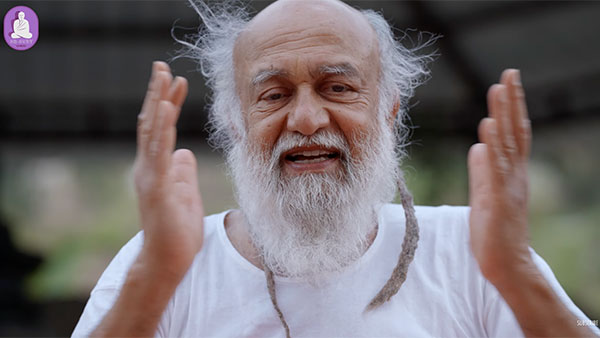
Baba shares how the aim and purpose of spirituality is to know yourself as the Consciousness of Existence.